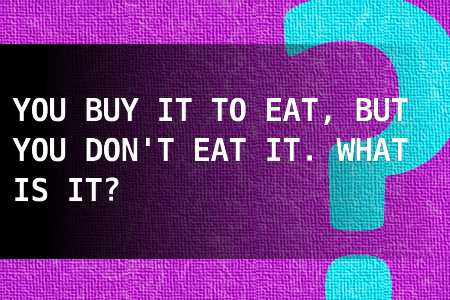
You buy it to eat, but you don...
[2039] You buy it to eat, but you don... - You buy it to eat, but you don't eat it. What is it? - #brainteasers #riddles - Correct Answers: 90 - The first user who solved this task is Djordje Timotijevic
BRAIN TEASERS
enter your answer and press button OK

You buy it to eat, but you don...

You buy it to eat, but you don't eat it. What is it?
Correct answers: 90
The first user who solved this task is Djordje Timotijevic.
#brainteasers #riddles
Register with your Google Account and start collecting points.
Check your ranking on list.

Infrequently

An elderly couple who are both widowed have been courting for a long time.

They decide it's finally time to get married. Before the wedding, they go out to dinner and talk about how their marriage might work.

They discuss finances, living arrangements and so on.

Finally, the man broaches the subject of their physical relationship.

"How do you feel about sex?" he asks, rather tentatively.

"I would like it infrequently," replies the old lady.

The old gentleman sits quietly for a moment, adjusts his glasses, leans over towards her and whispers: "Is that one word or two?"

Jokes of the day - Daily updated jokes. New jokes every day.
Follow Brain Teasers on social networks

Brain Teasers

puzzles, riddles, mathematical problems, mastermind, cinemania...

John Keill

Born 1 Dec 1671; died 31 Aug 1721 at age 49.Scottish mathematician and natural philosopher, who was a major proponent of Newton's theories. He began his university education at Edinburgh under David Gregory, whom he followed to Oxford, where Keill lectured on Newton's work, and eventually became professor of astronomy. In his book, An Examination of Dr. Burnett's Theory of the Earth (1698), Keill applied Newtonian principles challenging Burnett's unsupportable speculations on Earth's formation. In 1701, Keill published Introductio ad Veram Physicam, which was the first series of experimental lectures and provided a clear and influential introduction to Isaac Newton's Principia. He supported Newton against priority claims by Leibnitz for the invention of calculus. (James Keill was his younger brother.)«
This site uses cookies to store information on your computer. Some are essential to help the site properly. Others give us insight into how the site is used and help us to optimize the user experience. See our privacy policy.