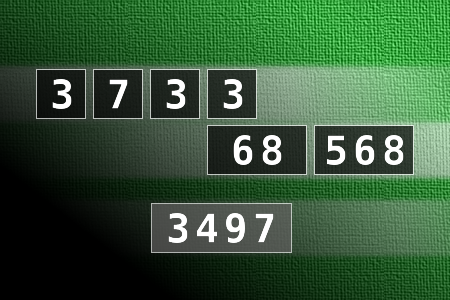
Calculate the number 3497
[6007] Calculate the number 3497 - NUMBERMANIA: Calculate the number 3497 using numbers [3, 7, 3, 3, 68, 568] and basic arithmetic operations (+, -, *, /). Each of the numbers can be used only once. - #brainteasers #math #numbermania - Correct Answers: 19 - The first user who solved this task is Nílton Corrêa De Sousa
BRAIN TEASERS
enter your answer and press button OK

Calculate the number 3497

NUMBERMANIA: Calculate the number 3497 using numbers [3, 7, 3, 3, 68, 568] and basic arithmetic operations (+, -, *, /). Each of the numbers can be used only once.
Correct answers: 19
The first user who solved this task is Nílton Corrêa De Sousa.
#brainteasers #math #numbermania
Register with your Google Account and start collecting points.
Check your ranking on list.

A lawyer walks into a bar and ...

A lawyer walks into a bar and sits down next to a drunk who is closely examining something held in his fingers. The lawyer watches the drunk for a while till he finally gets curious enough to ask what it is.

"Well," said the drunk, "it looks like plastic and feels like rubber."

"Let me have it," said the lawyer. Taking it, he began to roll it between his thumb and forefinger, examining it closely. "Yes," he finally said, "it does look like plastic and feel like rubber, but i don't know what it is. Where did you get it?"

"From my nose," the drunk replied.

Jokes of the day - Daily updated jokes. New jokes every day.
Follow Brain Teasers on social networks

Brain Teasers

puzzles, riddles, mathematical problems, mastermind, cinemania...

Lloyd Viel Berkner

Died 4 Jun 1967 at age 62 (born 1 Feb 1905).American physicist and engineer who first measured the extent, including height and density, of the ionosphere (ionized layers of the Earth's atmosphere), leading to a complete understanding of radio wave propagation and he helped develop radar systems, especially the Distant Early Warning system. He later investigated the origin and development of the Earth's atmosphere. Early in his career, he worked on radio navigation beacons for the Airways division of the Bureau of Lighthouses (1927-28), as radio engineer on the Byrd Antarctic expedition (1928-30). Returning to the U.S. Bureau of Standards (1930-33) he studied the ionosphere using radio-pulse transmissions, then terrestrial magnetism with the Carnegie Institution (1933-51).
This site uses cookies to store information on your computer. Some are essential to help the site properly. Others give us insight into how the site is used and help us to optimize the user experience. See our privacy policy.