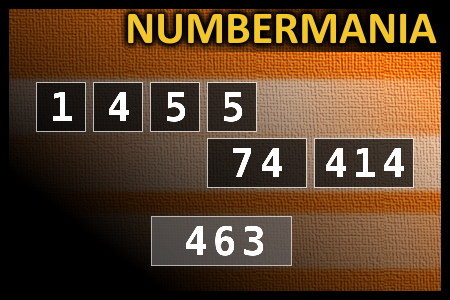
Calculate the number 463
[329] Calculate the number 463 - NUMBERMANIA: Calculate the number 463 using numbers [1, 4, 5, 5, 74, 414] and basic arithmetic operations (+, -, *, /). Each of the numbers can be used only once. - #brainteasers #math #numbermania - Correct Answers: 47 - The first user who solved this task is Sanja Šabović
BRAIN TEASERS
enter your answer and press button OK

Calculate the number 463

NUMBERMANIA: Calculate the number 463 using numbers [1, 4, 5, 5, 74, 414] and basic arithmetic operations (+, -, *, /). Each of the numbers can be used only once.
Correct answers: 47
The first user who solved this task is Sanja Šabović.
#brainteasers #math #numbermania
Register with your Google Account and start collecting points.
Check your ranking on list.

A professor of chemistry wante...

A professor of chemistry wanted to teach his 5th grade class a lesson about the evils of liquor, so he produced an experiment that involved a glass of water, a glass of whiskey, and two worms.
"Now, class, closely observe the worms," said the professor while putting a worm into the water.
The worm in the water writhed about, happy as a worm in water could be. He then put the second worm into the whiskey. It curled up and writhed about painfully, then quickly sank to the bottom, dead as a doornail.
"Now, what lesson can we learn from this experiment?" the professor asked.
Johnny, who naturally sits in back, raised his hand and wisely, responded confidently, "Drink whiskey and you won't get worms."
Jokes of the day - Daily updated jokes. New jokes every day.
Follow Brain Teasers on social networks

Brain Teasers

puzzles, riddles, mathematical problems, mastermind, cinemania...

Artturi Ilmari Virtanen

Born 15 Jan 1895; died 11 Nov 1973 at age 78.Finnish biochemist whose investigations directed toward improving the production and storage of protein-rich green fodder, vitally important to regions characterized by long, severe winters, brought him the Nobel Prize for Chemistry in 1945. The AIV method, named for his initials, was storing green fodder in an acid medium to prevent spoilage and retain nutritious nitrogenous material. He found that a mixture of hydrochloric and sulfuric acid was adequate as long as its strength was kept within certain precise limits (a pH of about four). In 1929, he found that cows fed such silage gave milk indistinguishable in taste from that of cows fed on normal fodder, while as rich in vitamins A and C.
This site uses cookies to store information on your computer. Some are essential to help the site properly. Others give us insight into how the site is used and help us to optimize the user experience. See our privacy policy.