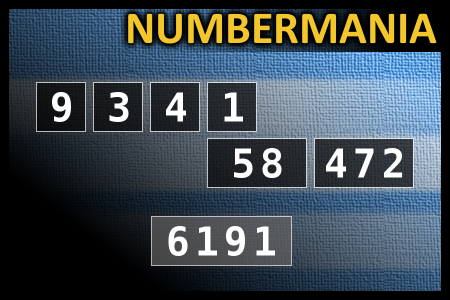
Calculate the number 6191
[1093] Calculate the number 6191 - NUMBERMANIA: Calculate the number 6191 using numbers [9, 3, 4, 1, 58, 472] and basic arithmetic operations (+, -, *, /). Each of the numbers can be used only once. - #brainteasers #math #numbermania - Correct Answers: 34 - The first user who solved this task is Sanja Šabović
BRAIN TEASERS
enter your answer and press button OK

Calculate the number 6191

NUMBERMANIA: Calculate the number 6191 using numbers [9, 3, 4, 1, 58, 472] and basic arithmetic operations (+, -, *, /). Each of the numbers can be used only once.
Correct answers: 34
The first user who solved this task is Sanja Šabović.
#brainteasers #math #numbermania
Register with your Google Account and start collecting points.
Check your ranking on list.

I Have A Question

A father and son went fishing one day. While they were out in the boat, the boy suddenly became curious about the world around him. He asked his father, "How does this boat float?
The father replied, "Don't rightly know son." A little later, the boy looked at his father and asked, "How do fish breath underwater?"
Once again the father replied, "Don't rightly know son." A little later the boy asked his father, "Why is the sky blue?"
Again, the father repied. "Don't rightly know son." Finally, the boy asked his father, "Dad, do you mind my asking you all of these questions?"
The father replied, "Of course not, you don't ask questions, you never learn nothin'."
Jokes of the day - Daily updated jokes. New jokes every day.
Follow Brain Teasers on social networks

Brain Teasers

puzzles, riddles, mathematical problems, mastermind, cinemania...

Johann Christian Fabricius

Born 7 Jan 1745; died 3 Mar 1808 at age 63.Danish entomologist who was one of the great entomologists of the 18th century. After studying with Swedish naturalist Linnaeus, Fabricius travelled widely in Europe to see insect collections and produced many publications describing all the new species that he saw. He named and classified some 10,000 species of insects. The system of classification of insects he developed was based on mouth structure (instead of wing). He offered theories, progressive for his time, suggesting that hybridization could produce produce new species or varieties, and that environmental adaptation could influence changes in anatomical structure or function.
This site uses cookies to store information on your computer. Some are essential to help the site properly. Others give us insight into how the site is used and help us to optimize the user experience. See our privacy policy.