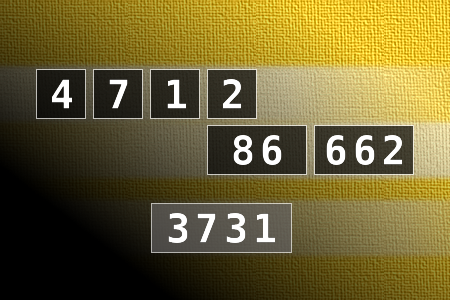
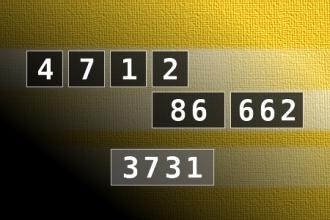
Calculate the number 3731
[4776] Calculate the number 3731 - NUMBERMANIA: Calculate the number 3731 using numbers [4, 7, 1, 2, 86, 662] and basic arithmetic operations (+, -, *, /). Each of the numbers can be used only once. - #brainteasers #math #numbermania - Correct Answers: 18 - The first user who solved this task is Djordje Timotijevic
BRAIN TEASERS
enter your answer and press button OK

Calculate the number 3731

NUMBERMANIA: Calculate the number 3731 using numbers [4, 7, 1, 2, 86, 662] and basic arithmetic operations (+, -, *, /). Each of the numbers can be used only once.
Correct answers: 18
The first user who solved this task is Djordje Timotijevic.
#brainteasers #math #numbermania
Register with your Google Account and start collecting points.
Check your ranking on list.

Finally, A Good Trump Joke

Donald is walking out of the White House and heading toward his limo, when a possible assassin steps forward and aims a gun.
A secret service agent, new on the job, shouts 'Mickey Mouse!'
This startles the would-be assassin and he is captured.
Later, the secret service agent's supervisor takes him aside and asks, 'What in the hell made you shout Mickey Mouse?'
Blushing, the agent replies, 'I got nervous. I meant to shout 'Donald, duck!'

Jokes of the day - Daily updated jokes. New jokes every day.
Follow Brain Teasers on social networks

Brain Teasers

puzzles, riddles, mathematical problems, mastermind, cinemania...

Lathe

In 1819, a U.S. patent for a profile lathe was issued to Thomas Blanchard of Middlebury, Connecticut. It was capable of manufacturing irregular forms, such as gun stocks. His machine used a friction-wheel to follow the surface of a sample pattern and a cutting wheel on the same shaft which would thus carve the workpiece to the same contour. It could produce the work of 13 operators, and thus provided the finished materials at much less cost. After inventing a tack-making machine at his brother's factory, Blanchard was recruited by the U.S. Armory at Springfield, Mass. to build machines to efficiently produce gun parts. Congress twice extended this patent, first to 1834, then to 1848, giving a total of 42 years in force.*
This site uses cookies to store information on your computer. Some are essential to help the site properly. Others give us insight into how the site is used and help us to optimize the user experience. See our privacy policy.