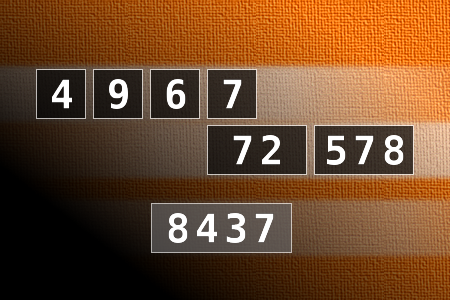
Calculate the number 8437
[6111] Calculate the number 8437 - NUMBERMANIA: Calculate the number 8437 using numbers [4, 9, 6, 7, 72, 578] and basic arithmetic operations (+, -, *, /). Each of the numbers can be used only once. - #brainteasers #math #numbermania - Correct Answers: 11 - The first user who solved this task is Nílton Corrêa de Sousa
BRAIN TEASERS
enter your answer and press button OK

Calculate the number 8437

NUMBERMANIA: Calculate the number 8437 using numbers [4, 9, 6, 7, 72, 578] and basic arithmetic operations (+, -, *, /). Each of the numbers can be used only once.
Correct answers: 11
The first user who solved this task is Nílton Corrêa de Sousa.
#brainteasers #math #numbermania

Register with your Google Account and start collecting points.
Check your ranking on list.

A sad-faced Doug walked into a...

A sad-faced Doug walked into a flower shop early one morning.
The clerk was ready to take his order for a funeral piece, based on the look on Doug's face, but soon realized his assumption was wrong as Doug asked for a basket of flowers sent to his wife for their anniversary.
"And what day will that be?" the clerk asked.
Glumly he replied, "Yesterday".
Jokes of the day - Daily updated jokes. New jokes every day.
Follow Brain Teasers on social networks

Brain Teasers

puzzles, riddles, mathematical problems, mastermind, cinemania...

Optical pulsar announced

In 1969, the New York Times made public the news of the discovery a few days earlier of the first optical pulsar by astronomers at the University of Arizona on 16 Jan 1969. It was the result of a year's search using a stroboscopic technique. Flashes of light in the optical range were found coming from the same location in the Crab Nebula as a previously known pulsar emitting radio bursts. The rate of pulsation of the two signals was found to be the same, and thus presumed to be from a single star. Other observatories were immediately notified and the flashing was confirmed by the McDonald Observatory and by the powerful 84-inch reflector telescope at the Kitt Peak National Observatory in Arizona. The star was flashing at a rate of about 30 times per second, with intermediate flashes of lesser intensity.
This site uses cookies to store information on your computer. Some are essential to help the site properly. Others give us insight into how the site is used and help us to optimize the user experience. See our privacy policy.