Daily Brain Teasers for Tuesday, 22 October 2019

|
puzzles, riddles, mathematical problems, word games, mastermind, cinemania, music, stereograms, ... |
What a winning combination?
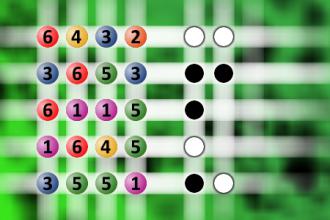 The computer chose a secret code (sequence of 4 digits from 1 to 6). Your goal is to find that code. Black circles indicate the number of hits on the right spot. White circles indicate the number of hits on the wrong spot.
 The first user who solved this task is Nasrin 24 T.
#brainteasers #mastermind
Calculate the number 6920
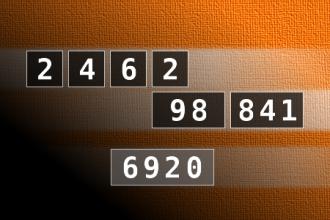 NUMBERMANIA: Calculate the number 6920 using numbers [2, 4, 6, 2, 98, 841] and basic arithmetic operations (+, -, *, /). Each of the numbers can be used only once.
 The first user who solved this task is Nílton Corrêa de Sousa.
#brainteasers #math #numbermania
Find number abc
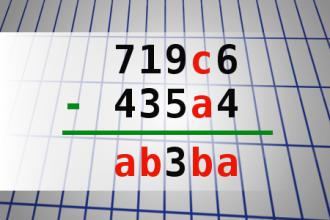 If 719c6 - 435a4 = ab3ba find number abc. Multiple solutions may exist.
 The first user who solved this task is Nasrin 24 T.
#brainteasers #math

In case of emergency...
In case of emergency pull poster off wall end tear along dotted lines.
Find the right combination
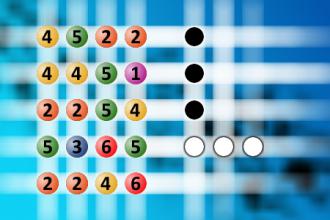 The computer chose a secret code (sequence of 4 digits from 1 to 6). Your goal is to find that code. Black circles indicate the number of hits on the right spot. White circles indicate the number of hits on the wrong spot.
 The first user who solved this task is Nasrin 24 T.
#brainteasers #mastermind
Clinton Joseph DavissonBorn 22 Oct 1881; died 1 Feb 1958 at age 76. American physicist who shared the Nobel Prize for Physics in 1937 (with Englishman George P. Thomson) for discovering that electrons can be diffracted like light waves, thus verifying the thesis of Louis de Broglie that electrons behave both as waves and as particles. Davisson studied the effect of electron bombardment on surfaces, and observed (1925) the angle of reflection could depend on crystal orientation. Following Louis de Broglie's theory of the wave nature of particles, he realized that his results could be due to diffraction of electrons by the pattern of atoms on the crystal surface. Davisson worked with Lester Germer in an experiment in which electrons bouncing off a nickel surface produced wave patterns similar to those formed by light reflected from a diffraction grating, and supporting de Broglie's electron wavelength = (h/p). This discovery has been applied to the study of nuclear, atomic, and molecular structure. Davisson helped develop the electron microscope which uses the wave nature of electrons to view details smaller than the wavelength of visible light. |
Calculate the number 6705
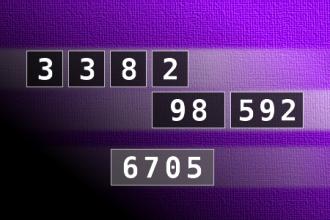 NUMBERMANIA: Calculate the number 6705 using numbers [3, 3, 8, 2, 98, 592] and basic arithmetic operations (+, -, *, /). Each of the numbers can be used only once.
 The first user who solved this task is Fazil Hashim.
#brainteasers #math #numbermania
MAGIC SQUARE: Calculate A-B+C
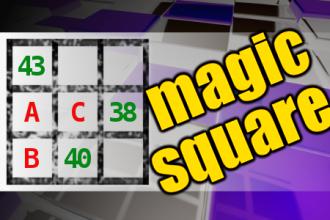 The aim is to place the some numbers from the list (1, 3, 5, 8, 25, 27, 30, 38, 40, 42, 43) into the empty squares and squares marked with A, B an C. Sum of each row and column should be equal. All the numbers of the magic square must be different. Find values for A, B, and C. Solution is A-B+C.
 The first user who solved this task is Nasrin 24 T.
#brainteasers #math #magicsquare
Find number abc
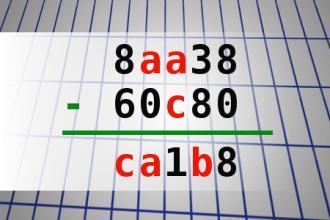 If 8aa38 - 60c80 = ca1b8 find number abc. Multiple solutions may exist.
 The first user who solved this task is Nasrin 24 T.
#brainteasers #math
What a winning combination?
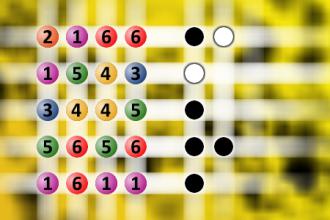 The computer chose a secret code (sequence of 4 digits from 1 to 6). Your goal is to find that code. Black circles indicate the number of hits on the right spot. White circles indicate the number of hits on the wrong spot.
 The first user who solved this task is Nasrin 24 T.
#brainteasers #mastermind
Calculate the number 9157
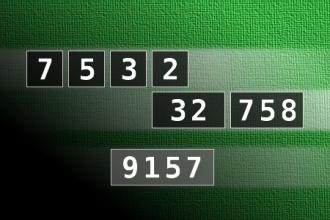 NUMBERMANIA: Calculate the number 9157 using numbers [7, 5, 3, 2, 32, 758] and basic arithmetic operations (+, -, *, /). Each of the numbers can be used only once.
 The first user who solved this task is Nílton Corrêa de Sousa.
#brainteasers #math #numbermania
Find number abc
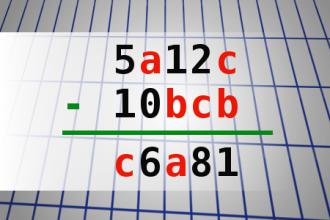 If 5a12c - 10bcb = c6a81 find number abc. Multiple solutions may exist.
 The first user who solved this task is Nasrin 24 T.
#brainteasers #math


